


Maintaining clean and accurate data is crucial for effective communication, compliance, and cost‑efficiency.
Data suppression helps you identify and manage records that are outdated, incorrect, or no longer relevant.
What Is Data Suppression?
Data suppression involves comparing your customer data against trusted external sources to flag or remove:
- Deceased individuals
- People who have moved (Goneaways)
- Those registered with opt‑out services such as the Telephone Preference Service (TPS) or Corporate Telephone Preference Service (CTPS)
By doing so, you ensure your communications reach the right audience, reduce waste, and stay compliant with regulations like GDPR.
Data Suppression
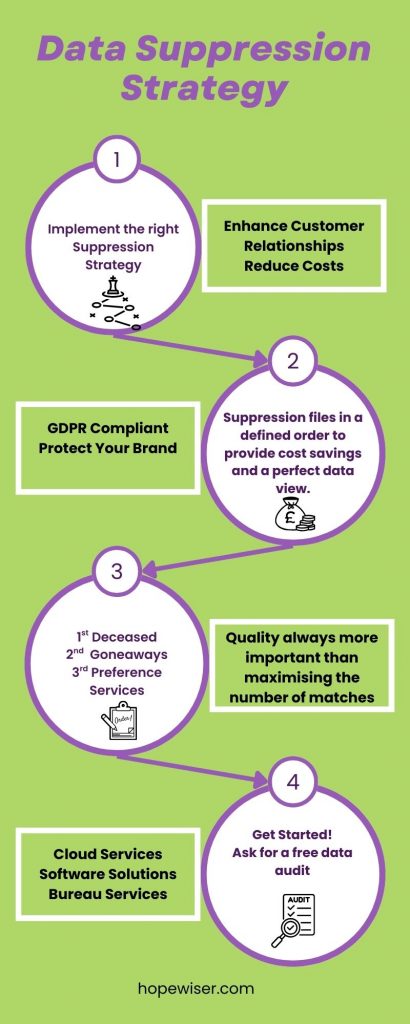
Implementing the right suppression strategy.
The right suppression strategy can bring a number of benefits:
- Enhance Customer Relationships: Ensure your messages reach the intended recipients.
- Reduce Costs: Avoid spending on undeliverable mail.
- Stay Compliant: Meet GDPR and other regulatory requirements.
- Protect Your Brand: Prevent negative publicity from misdirected communications.
Key Questions to Consider When Reviewing Your Suppression Strategy
When did you last review?
If it’s been more than three years since your last suppression evaluation, it’s time to schedule a review. It’s important to check whether your current strategy is still achieving its objectives or whether improvements are needed.
Do you use a third party — and can you rely on them?
Many organisations rely on trusted data partners to implement and maintain their customer databases. It’s essential to understand the decisions behind your suppression strategy and when it was last reviewed.
With a wide range of suppression files available, it’s wise to compare all deceased and goneaway files on the market, as new products emerge and existing ones evolve.
If you rely on a third party, ensure they are providing a comprehensive solution that meets your requirements and complies with GDPR.
How do I implement the waterfall effect?
Suppression files are typically charged on a ‘per hit’ basis. This means some providers benefit from identifying as many goneaway or deceased records as possible — making the order of matching extremely important.
Hopewiser has spent more than 40 years in the data cleansing market and has developed routines that identify clear and obvious matches, while allowing for minor misspellings without drifting into overly ‘fuzzy’ matching. Suppression files are applied in a defined sequence, using multiple sources, to maximise the accuracy of your data.
Deceased files are checked first, as individuals may move towards the end of their life, but once they have passed away there is no need to identify forwarding addresses. Goneaways are verified next, along with any potential forwarding information. Finally, any remaining preference‑related checks are applied. This standard order helps minimise client costs, though it can be adjusted if certain data types are more relevant.
For Hopewiser, the quality of the match is always more important than maximising the number of matches. The aim is to give you a clear, accurate view of your data through a range of cloud‑based tools, stand‑alone software, integrations, and bureau services.
How Hopewiser Can Help
Hopewiser offers a range of solutions to cleanse and validate your data:
- Cloud Services: Fast, accurate online tools with user‑friendly interfaces.
- Software Solutions: Customisable options for large data users.
- Professional Services: Expert consultants to support complex data projects.
All services utilise the latest suppression files and ensure secure data handling.
Get Started Today
Ready to improve your data quality? Contact Hopewiser for a free data quality audit and discover how our suppression services can benefit your organisation.
, updated 2nd January 2026.
Topic: Data Cleansing